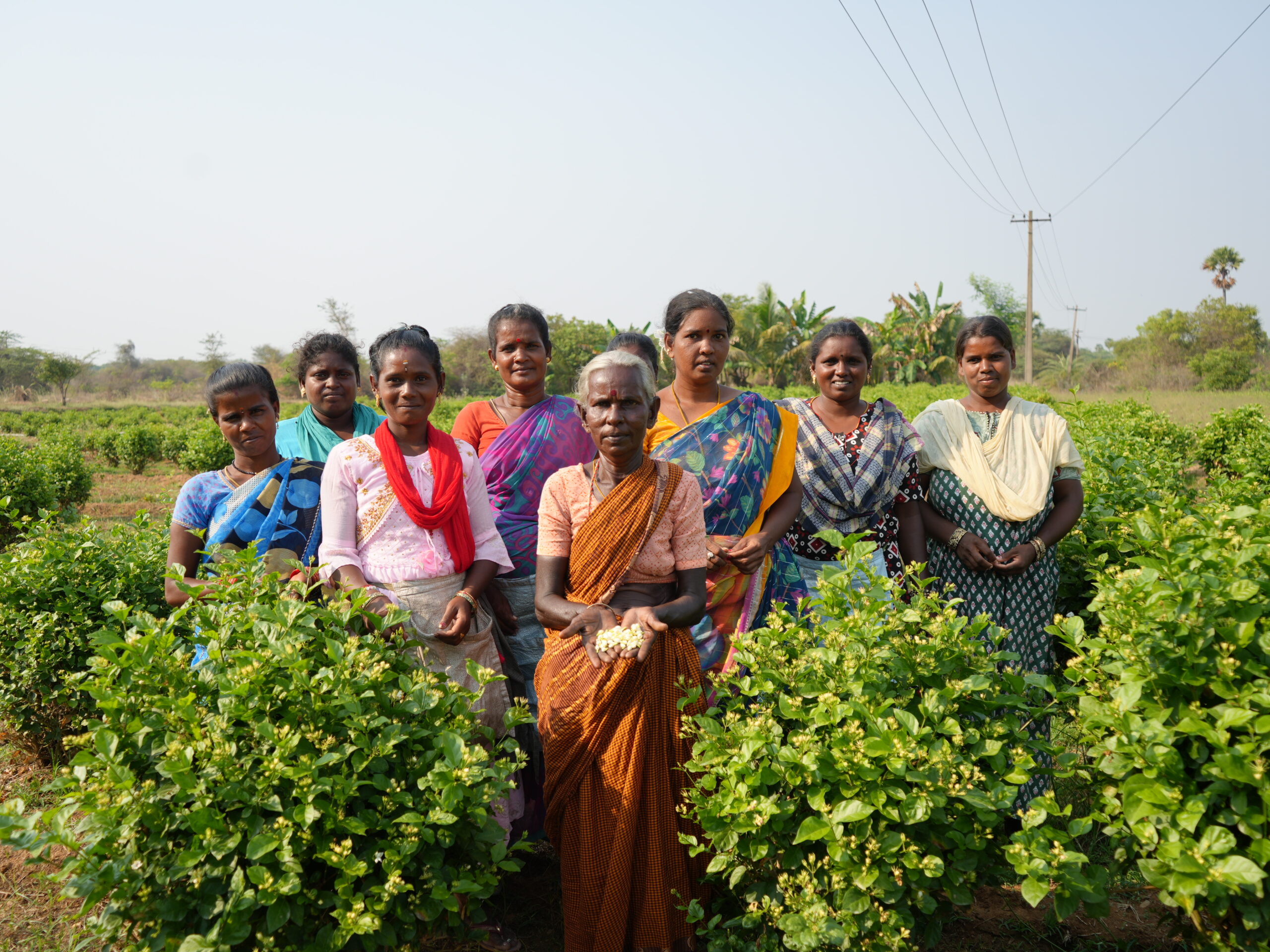
At mid-noon in Thalavedu, a hamlet in rural Tamil Nadu, the women of the Irular colony gather in the open space between their homes. Conversations drift from everyday matters to household decisions, and sometimes what begins as casual talk settles into something important. Until recently, these gatherings were routinely cut short. A pot left on the brick stove, a meal still hours away from being ready, would pull someone away.
Thalavedu sits far from the city, its small homes set close together, opening out to fields, a peepal tree, a village tank, and small temples dotting the paths. It is home to part of the Irular community, one of the largest indigenous groups in Tamil Nadu. For generations, Irular families lived with the forest, foraging, hunting, reading its rhythms with knowledge built across generations.
As access to forest resources has narrowed, most of the 96 families here now earn through daily wages. The men head to brick kilns or collect wood. The women turn to the jasmine shrubs that bloom every morning, shrubs sprayed several times a day with insecticide. “When we pluck the flowers, we come in contact with these pesticides. We get allergies, and our bodies and muscles ache all over,” says Lakshmi, who like most women here, splits her days between the jasmine fields and her home. A kilogram of flowers (a full day’s picking) fetches her about 50 rupees.
Cooking used to swallow the afternoon. On the traditional mud-brick stove, Lakshmi would begin a meal at 2 pm and still be at it past five. A big log of firewood burned to feed the family once. Utensils came away black. “It was quite difficult to scrub the pots clean with all the black soot. Our chest would ache in the process, we would cough a lot, and our eyes would sting,” she says. Soot settled everywhere, on pots, on bricks, on skin, and on the air the women and children breathed.
In other states, our team had already seen what traditional cooking methods can cost a household: hours of the day, lungfuls of smoke, walls covered with soot, utensils that could not be scrubbed clean. Our work in Thalavedu, part of the Harit Jeevan project supported under a CSR initiative, began with a careful mapping of the colony. Every household was listed on the first round of visits. On the second, the team went back to understand what each family already had. The improved cookstoves were then handed over at a distribution event.
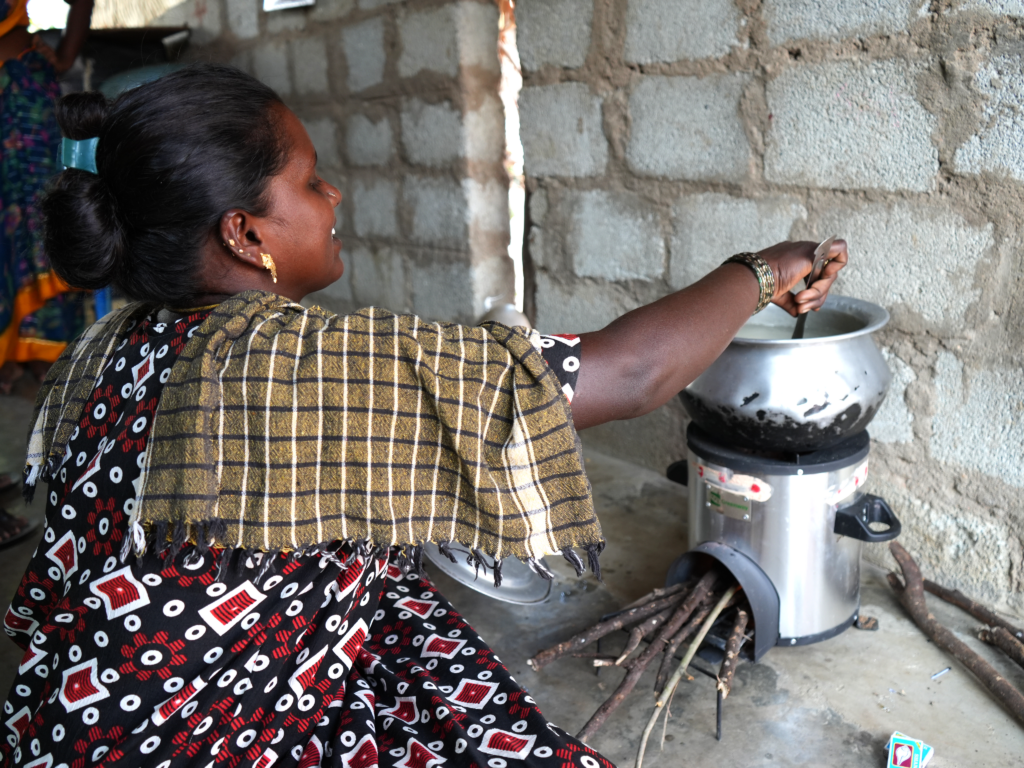
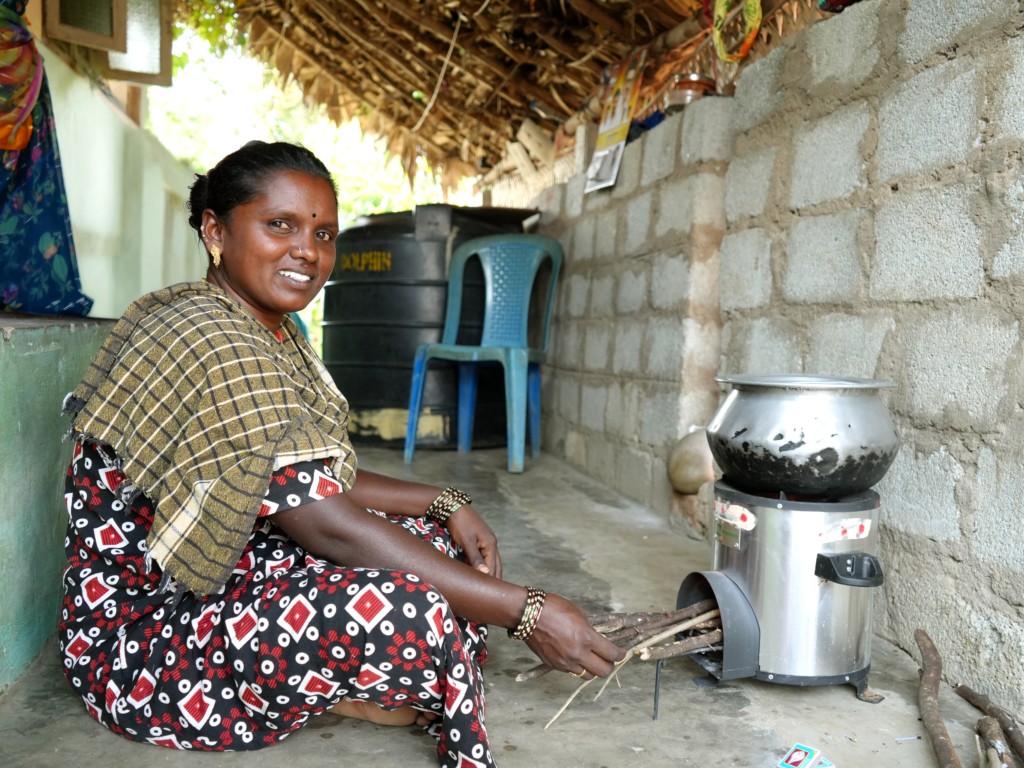
From the first meal Lakshmi prepared on her improved cookstove, the difference was clear. “If we start at 2 pm, we can close cooking by 2:30,” Lakshmi says, with a slight smile. Where a big log once went into a single meal, a few small pieces of firewood now do the job. “The wood we collect once lasts us a week.” There is far less soot, and the smoke has thinned. The fire, she says simply, “burns well.” And the scrubbing, the coughing, the stinging eyes are subsiding too. “Now it has become easy…for everybody.”
These days, when Lakshmi walks to join the other women at mid-noon, she isn’t racing against a pot on the stove.
The improved cookstoves distribution in Thalavedu is part of a larger project, supported by one of our CSR donors. The initiative brings together clean energy, improved cooking solutions, STEM education, and safe water access for marginalized communities in Tamil Nadu, Madhya Pradesh, and Karnataka.