Four-year-old Pranav arrives at our Early Intervention Center laughing. He has had his breakfast at home, and his mother or his elder sister Jhalak has gotten him ready. “As soon as he enters inside, he becomes very happy,” his father, Desh Raj, says. “If he’s in the mood, then no matter what you do, he keeps laughing, playing, and doing his exercises.”
That joy is hard-won. A year ago, Pranav could not sit or stand without support.
Pranav is four years old and has cerebral palsy, which affects movement and muscle control on the right side of his body. For the past year, he has been coming to our center in Khanpur, Delhi, where our team of professionals works with him on physiotherapy, occupational therapy, speech therapy, and special education. His father comes along. So, often, does Jhalak, someone Pranav clearly adores. She is a constant presence, cheering him on at the center, practicing his exercises with him at home, and reminding him, at every turn, that he is deeply loved.
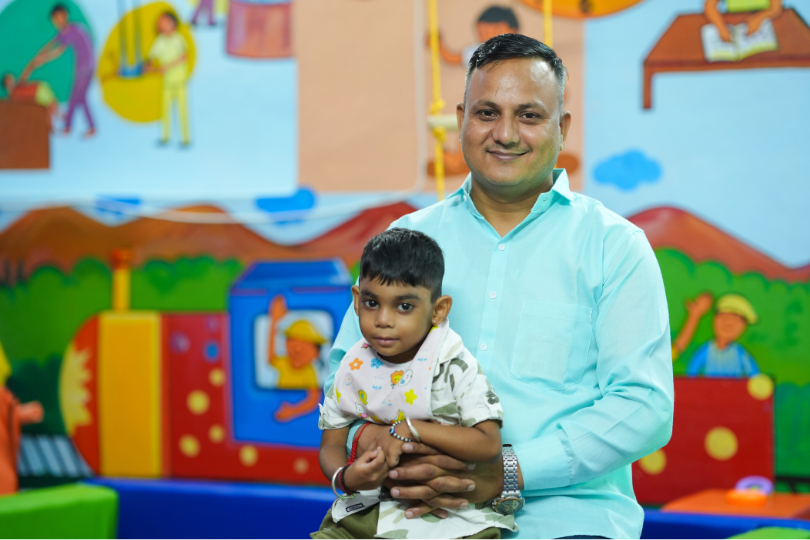
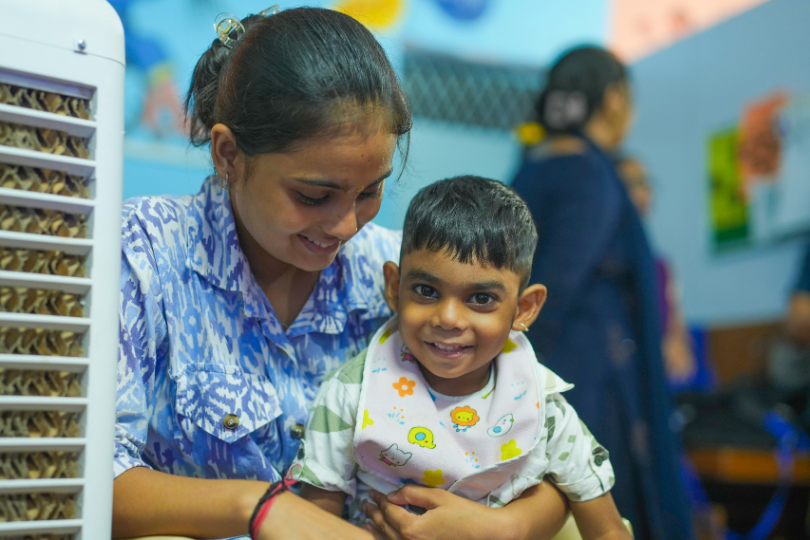
On the left, Pranav with his father, Desh Raj. On the right, Pranav with his elder sister Jhalak.
Ifrah, a physiotherapist on our team at the center, has been working with Pranav from the start and is quick to say she doesn’t bring the progress about on her own. “Even if a child makes a tiny movement, it creates a very big impact, because a lot of hard work goes into bringing that tiny movement,” she explains. “The same hard work also comes from the parents’ side. If I talk about Pranav, his father’s efforts were equal to mine.”
The family came to know about their child’s condition when Pranav was two years old. At that time, they found a therapy center near their home. “That center was also good, but there were too many children there. The kind of improvement we wanted to see in our child was not happening because of the crowd,” recalls Desh Raj. A while later, a contact told the family about our Early Intervention Centre. “They gave us the address and said it was nearby and free of cost,” he says.
When Pranav came in for his first assessment, Ifrah recalls, “He had limited neck and head control and overall balance. He could not sit without support.” His right hand was held in a tight fist; the muscles were so tight, she says, that his fingers had no flexibility at all. She decided the work had to start from the core.
That meant a combination of strengthening and stretching exercises for the whole body, balance and coordination training, and core muscle work. “With the help of electrotherapy and occupational therapy, his fine motor movements and finger movements improved,” says Ifrah. “Earlier, he would drool a lot, but with oral motor exercises, it has reduced significantly. At the same time, Pranav’s speech has also improved considerably thanks to speech therapy.”
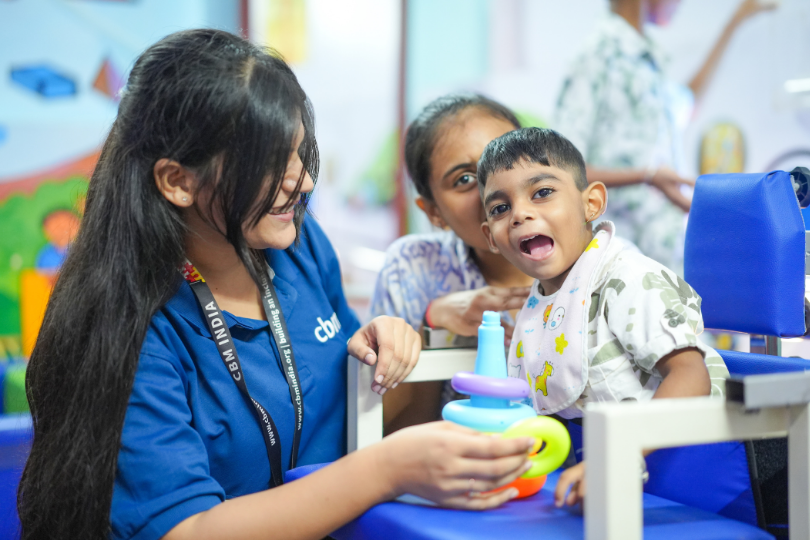
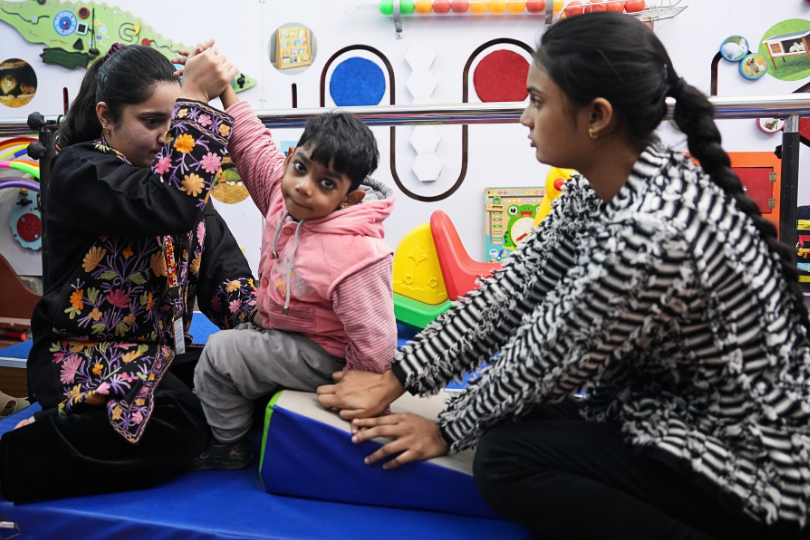
The early weeks were hard. “His body was stiff,” Desh Raj remembers. “Because of that stiffness, during the exercises done by the staff, the child used to cry.” It must have been hard for the family, knowing the therapy was necessary, yet having to hold steady through their child’s tears. But after only a month and a half, they started noticing changes. “We could see movement coming into his body,” he says. “He started holding things, understanding things. That’s when we saw the improvement.”
Ifrah too, noticed the same progress.
Pranav’s fist has opened completely. He can hold objects and lift them. He is now able to sit properly. He can also stand with minimal support.
For Desh Raj, the day his son first sat on his own is not something he needs to think hard to remember. “Seeing Pranav sit and stand gives us hope every day. We are very thankful to the team for helping our child,” he shares.
The progress isn’t confined to his mobility. Pranav is more alert, more curious, and more present. He’s able to follow instructions, responds well to structured activities, and enjoys being engaged. The team at our Early Intervention Center is now working with Pranav to prepare him for school.